

Key Takeaways
- MMA injuries often develop gradually, with repeated joint loading contributing to cumulative strain rather than a single acute event.
- Joint locks place stress on ligaments, tendons, and cartilage, which may lead to instability or structural changes over time.
- Both acute injuries from joint locks and cumulative joint stress are common in BJJ and MMA, although acute injuries may account for a larger proportion of cases seen in clinical practice.
- Early assessment of persistent pain or instability can help identify underlying issues before they progress further.
MMA Injuries: The Long-Term Impact of Joint Locks on Joint Health
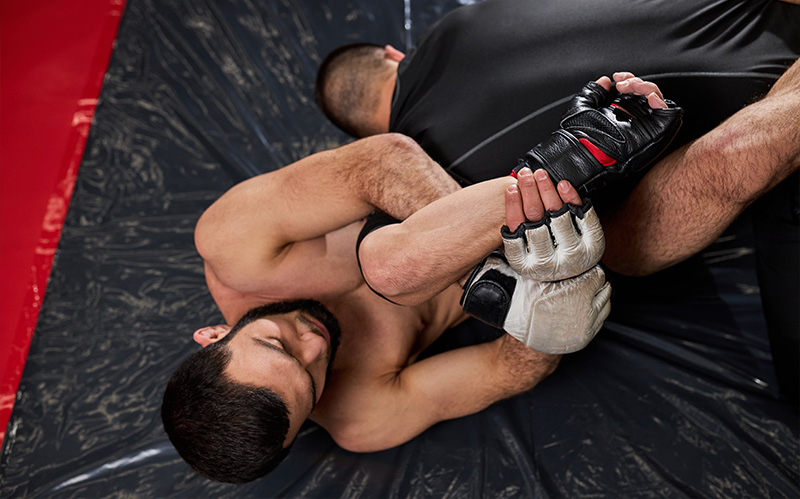
Joint locks are a key element of grappling disciplines such as Brazilian Jiu-Jitsu (BJJ) and mixed martial arts (MMA). They are applied to control an opponent by placing a joint under increasing tension, to the point where further resistance risks structural injury.In discussions about MMA injuries, attention is often focused on acute events such as fractures or ligament tears. However, the cumulative effect of repeated joint loading during training is less visible, but equally relevant. Over time, this can influence joint function, particularly when recovery and load management are not adequately balanced.
1. How Joint Locks Affect the Musculoskeletal System
Joint locks work by forcing a joint towards or beyond its normal range of motion. Depending on the technique, this may involve hyperextension, rotational force, or sustained compression.
These forces are not isolated to the joint itself; they are transmitted through a network of stabilising structures, including ligaments, tendons, and surrounding muscle groups.
When these forces are applied repeatedly, even at submaximal levels, microtrauma can occur. This does not always produce immediate symptoms; instead, the tissue response is gradual.
Repeated acute injuries may have more significant implications for long-term joint health. For example, a ligament injury caused by a joint lock may leave the joint less stable, particularly if the ligament does not fully recover or if further injuries occur. Recurrent instability can alter the way forces are distributed across the joint, potentially placing greater stress on the cartilage and other structures. Over time, this may contribute to degenerative changes within the affected joint.
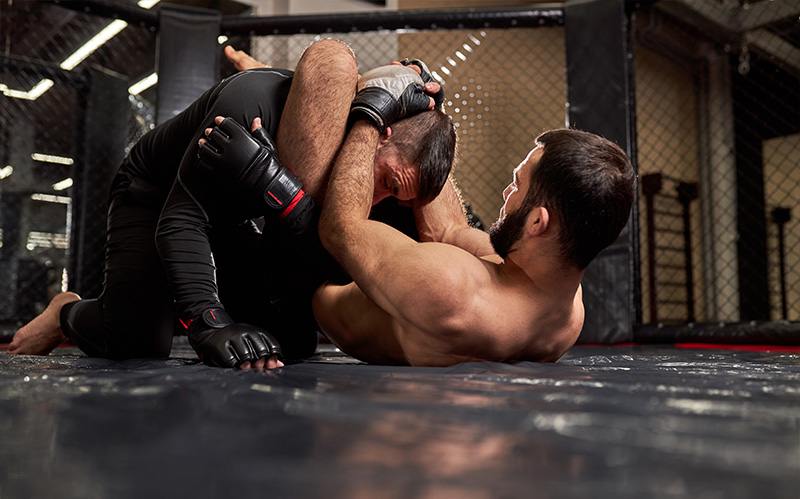
This pattern is commonly observed in MMA joint damage, where there is no single defining injury, but a gradual shift in joint behaviour. In BJJ, the high frequency of controlled sparring means joints are repeatedly exposed to these stress patterns, often several times within a single training session. These repeated patterns may result in joint injuries that might require medical observation.
2. Commonly Affected Joints in Combat Sports
The specific joint affected often reflects the mechanics of particular submission techniques. While multiple joints can be affected, the elbow, shoulder, and knee are consistently identified as higher-risk areas.
Elbow
The elbow is particularly vulnerable because of its hinge-like structure. Arm bars can force the elbow beyond its normal range of motion, causing an elbow hyperextension injury involving the joint capsule or surrounding ligaments.
If the submission is released before the joint’s structural limit is exceeded, injury may not occur. The greater concern is when the limit is breached, the ligament is injured, then later exposed to another similar injury before or after healing, creating a pattern of recurrent trauma.
Shoulder
The shoulder has a wide range of motion but relies heavily on soft tissue structures for stability. Techniques such as the Kimura and Americana apply rotational forces that place stress on the labrum and surrounding stabilisers.
This can contribute to shoulder instability in fighters, where the joint feels less secure during movement. Athletes may notice looseness or discomfort during overhead activities, or they may experience difficulty generating force.
When symptoms persist, some individuals seek assessment from a shoulder pain specialist to evaluate whether instability or soft tissue injury is present.
Knee
The knee is exposed to rotational stress during submissions such as heel hooks. Unlike the elbow, which primarily moves in a single plane, the knee contains structures that resist twisting forces.
Ligaments such as the anterior cruciate ligament (ACL) and structures such as the meniscus are particularly vulnerable to rotational loads. Injuries in this region often present with swelling, instability, or mechanical symptoms such as catching or locking. In clinical settings, these presentations are frequently associated with complaints of knee pain, especially in individuals who continue training despite early symptoms.
3. Long-Term Consequences of Repeated Joint Stress
Not every joint lock causes injury. In training, submissions are often released before the joint is pushed beyond its structural limits. The longer-term concern arises when a lock causes an acute injury and the same joint is subsequently injured again.
A ligament sprain or tear may heal, but some athletes can be left with residual laxity or instability. If the joint is repeatedly reinjured, this instability may become more persistent and affect how forces are transmitted across the joint during movement.
Previous joint trauma is also a recognised risk factor for later degenerative change. Injuries involving cartilage, ligaments, or other joint structures can increase the likelihood of post-traumatic osteoarthritis developing over time, although this does not occur in every athlete.
For fighters, the practical issue is therefore less about how often a joint is placed into a controlled submission position and more about whether actual injuries are occurring, how completely they recover, and whether the same joint continues to be reinjured.
4. Acute Injury Versus Cumulative Damage
Joint-related problems in combat sports generally fall into two categories: acute injury and cumulative damage.
Acute injuries occur when a joint lock is applied with sufficient force to exceed the structural limits of the tissue. This may result in a ligament rupture, dislocation, or cartilage injury. These injuries are typically associated with immediate pain and functional limitation.
Cumulative damage, by contrast, develops gradually. Athletes may continue training through mild discomfort, particularly if the symptoms do not significantly impair performance. Over time, however, repeated microtrauma can lead to more noticeable changes in joint function.
This distinction is important from a clinical perspective. Many athletes seek medical evaluation only when symptoms interfere with training or daily activities. At this stage, underlying structural changes may already be present.
Assessment typically involves a detailed clinical examination, supported by imaging where necessary. MRI scans, for example, are useful for evaluating soft tissue structures such as ligaments, tendons, and cartilage.
5. Orthopaedic Considerations for Longevity in Combat Sports
Joint locks remain a fundamental aspect of grappling and, as such, cannot be removed from training. Therefore, the focus shifts towards how athletes manage their exposure to joint stress.
Muscle strength plays a key role in joint stability. Well-conditioned muscles help to absorb and distribute force, reducing the load placed directly on ligaments and cartilage. Training intensity and frequency also influence how joints respond over time.
Technical control during sparring is another factor. Submissions applied in a controlled manner allow the receiving athlete time to respond, reducing the likelihood of abrupt force being transmitted through the joint.
Recovery, often overlooked, is a central consideration. Soft tissues require time to adapt to repeated loading. Without sufficient recovery, the risk of cumulative damage increases.
When symptoms such as persistent pain, instability or mechanical restriction are present, further evaluation may be considered. Athletes experiencing ongoing shoulder symptoms may consult a doctor for shoulder pain to assess whether instability or soft tissue injury is present. Clinical assessment focuses on determining whether the issue relates to transient strain or an underlying structural injury, which can guide appropriate management.
Conclusion: A Structural Perspective on Joint Health in Combat Sports
Joint locks create predictable mechanical stress across specific joints. In the context of MMA injuries, both acute injury and cumulative damage influence how these joints change over time.
The elbow, shoulder, and knee are particularly vulnerable due to the nature of grappling techniques. Repeated exposure to hyperextension, rotation, and compression may contribute to ligament laxity, cartilage wear, and early degenerative changes, especially when symptoms are not addressed promptly.
However, not all joint discomfort indicates structural injury. Some symptoms may reflect temporary overload and can stabilise with appropriate adjustments to training and recovery protocols.
Dr Bryan Tan is a fellowship-trained orthopaedic surgeon who manages sports-related joint conditions affecting the shoulder, elbow, and knee. His clinical approach includes detailed assessment and, where indicated, imaging to evaluate soft-tissue structures and joint stability.
If joint pain or instability is affecting your training, schedule a consultation with Dr Bryan Tan to assess your condition and discuss treatment options.



 Dr Bryan Tan